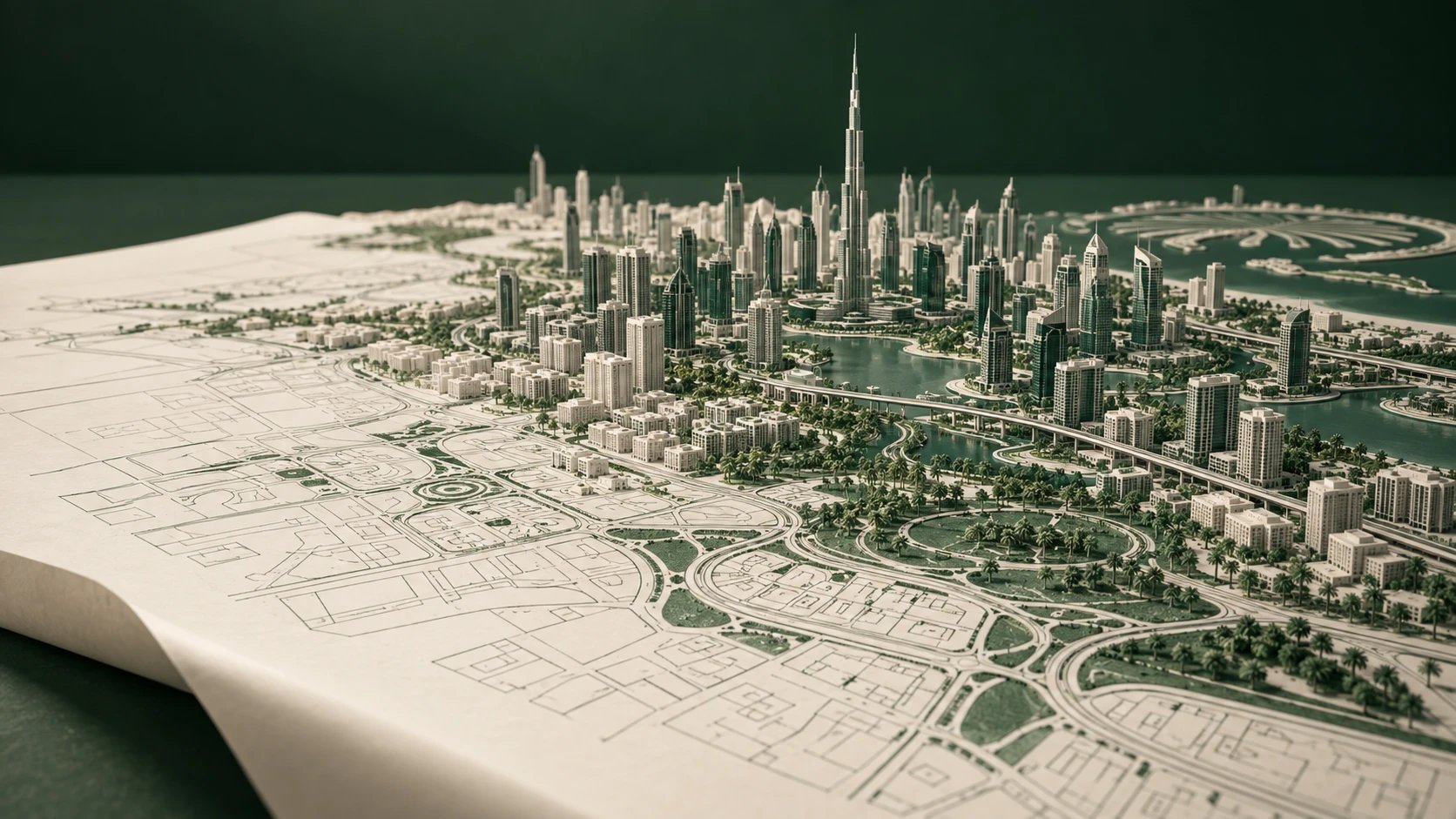
The Dubai 2040 Urban Master Plan is the emirate’s seventh development blueprint since 1960. It sets where Dubai will place its people, its density and its green space for the next two decades. For an investor, that makes it the most useful long-range document the city publishes.
01, Why the plan existsSix decades of planned growth
Dubai is often described as fast. It is more accurate to call it deliberate. Its growth has followed a published plan since 1960, and the 2040 plan is the seventh.
Between 1960 and 2020, Dubai’s population rose from roughly 40,000 to 3.3 million. Over the same period the built-up area expanded 170 times from 3.2 square kilometres. Very little of that was left to chance.
The 2040 plan sets the next chapter. It concentrates growth inside the existing city rather than pushing it outward. It raises density around mass transit stations, doubles green and leisure space, and protects the emirate’s natural areas.
Infrastructure comes before price. A plan that states where the infrastructure is going also signals where long-run demand is likely to concentrate.
02, The five urban centresWhere the density is directed
The plan organises growth around five urban centres. Three are established. Two are new. For an investor this is the most useful page of the plan, because it shows where the city intends to put people and amenity.
| Centre | Status | Role in the city |
|---|---|---|
| Deira and Bur Dubai | Established | The historic core and the city’s original trading district. |
| Downtown and Business Bay | Established | The financial and commercial spine of the city. |
| Dubai Marina and JBR | Established | The principal waterfront residential and leisure district. |
| Expo 2020 Centre | New | A new centre on the Expo 2020 site, supporting exhibitions, tourism and logistics. |
| Dubai Silicon Oasis Centre | New | A new centre for technology and knowledge-based industry. |
The plan also sets a hierarchy of community sizes, from neighbourhoods of a few thousand people to towns of more than a million. Each level is planned with the services its population needs. The question is not only which centre, but how close an address sits to the services and transit the plan commits to its community.
03, The targetsWhat the city commits to by 2040
Read together, the targets describe a city adding people while giving more of its land to open space, coast and services. Coastline and green space cannot be widened at will. As the population grows, addresses with access to both carry a structural advantage.
04, Eight objectivesWhat the plan sets out to do
The plan states eight objectives. Together they bring every urban initiative in the emirate under one framework, aligned with its economic priorities.
| Upgrade the urban areas | Regenerate the five urban centres, three established and two new. |
| Use resources efficiently | Concentrate development inside existing city limits rather than spreading outward. |
| Build healthy, inclusive communities | Double green and leisure areas, and plan each community around the services it needs. |
| Move people sustainably | Prioritise public transport, walking and cycling, with density raised around mass transit stations. |
| Attract investment to new sectors | Foster economic activity and draw foreign investment into new industries. |
| Protect the environment | Safeguard nature reserves and rural natural areas. The plan includes a development plan for Hatta. |
| Preserve heritage | Protect the emirate’s cultural and urban heritage and its older neighbourhoods. |
| Govern growth | Legislation and a governance model for sustainable development, supported by a shared planning database. |
The thread through all eight: growth is directed, not left to the market. Density follows transit, and transit follows the plan.
05, Reading it as an investorWhat it tells you, and what it does not
We do not buy a city’s optimism. We read its commitments. The 2040 plan is a commitment, legislated and already visible on the ground. Used properly, it is a filter for every allocation decision.
| What it tells you | What it does not tell you |
|---|---|
| Hold for the long term. A twenty-year plan rewards a long hold. Infrastructure matures into value over years, not launch cycles. | The price of any asset. The plan says where the city grows. It says nothing about whether a given asset is fairly priced today. |
| Choose location against the plan. Weigh an address against the plan’s centres, transit and amenity, not against this month’s launch incentives. | Timing. Targets run to 2040. Delivery is staged, and individual projects can slip or be revised. |
| Favour what cannot be replicated. Coast, green space and transit access are finite. The plan adds people faster than it can add any of them. | Supply in your district. A growth centre attracts developers as well as residents. New supply has to be checked district by district. |
Four questions we ask of any address
| Which centre does it serve? | Is it inside, or connected to, one of the five urban centres? |
| How close is the transit? | Density is being raised around mass transit stations. Walking distance matters. |
| What is being built nearby? | Committed schools, healthcare, parks and beach access, weighed against competing supply. |
| Who is the developer? | Delivery record, handover history and build quality, before the brochure. |
Source: Dubai 2040 Urban Master Plan, Government of Dubai, launched March 2021 (WAM, Dubai Media Office). Population and land-use figures are the plan’s stated targets, not forecasts, and targets may be revised. This article is general commentary and does not constitute financial, legal or tax advice. Download this briefing as a PDF.