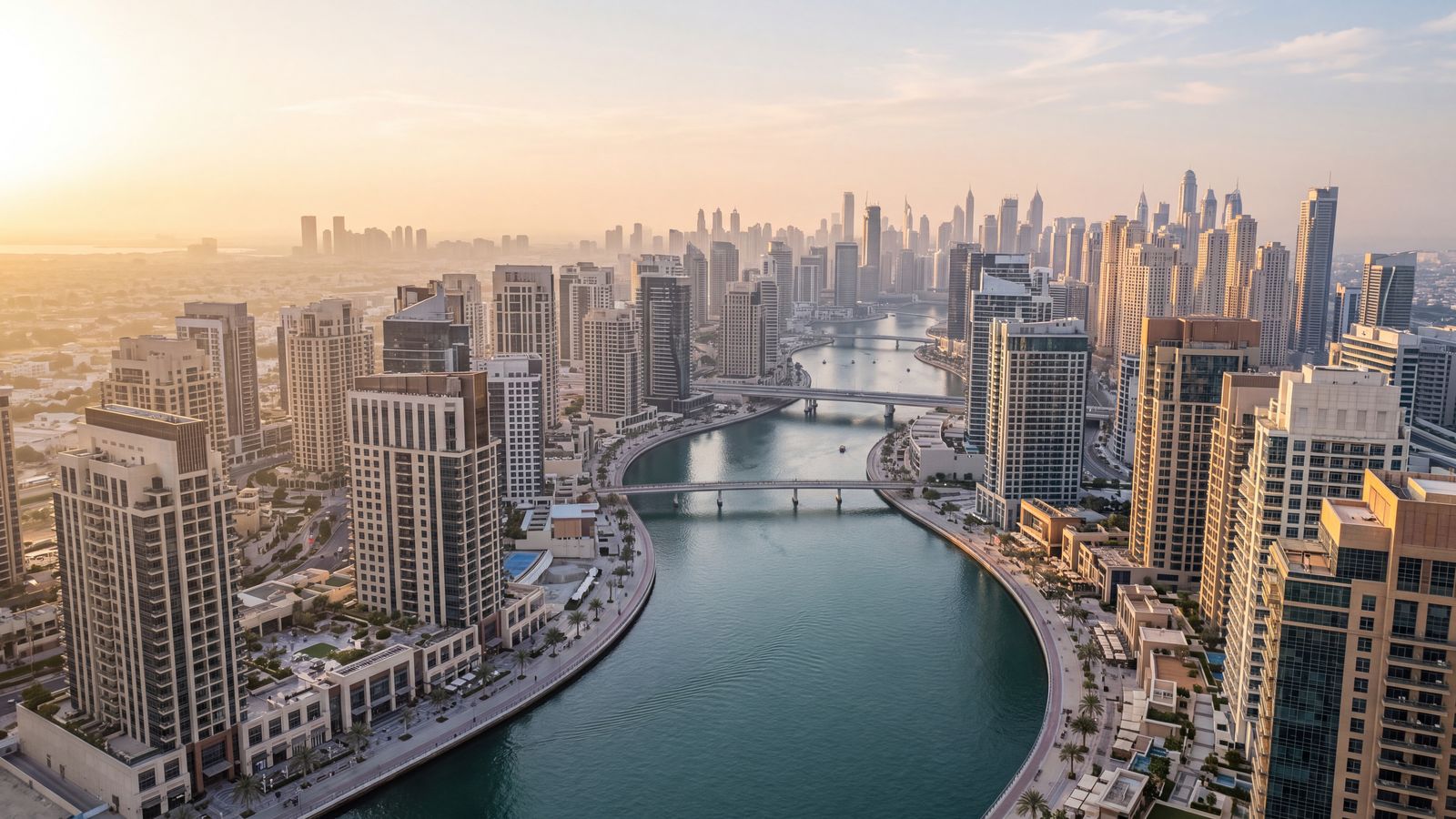
IThe market: liquid, well let, and plentiful
Apartments are most of Dubai's homes and almost all of what it is building. They are the easiest home to let and to sell, and they earn more rent for their price than houses do. That makes them the core of most investors' Dubai holdings, and the part of the market where choosing well matters most.
The record. ValuStrat's index values the same basket of homes every month, with the first quarter of 2021 set at 100. In August 2026 its apartment index stood at 168 and its villa index at 292 (ValuStrat, via Khaleej Times, September 2026). On registered prices, REIDIN put the moving-average median apartment at AED 1,780 per sq ft in July 2026, 0.1 percent up on a year.
The supply. Developers build apartments because a tower returns more saleable floor area per plot than a street of houses. Of the 564,072 homes under construction in August 2026, 495,775 were apartments. Buyers had already taken 74.1 percent of them, against 85.4 percent of the villas being built (fäm Properties on DLD data, via Khaleej Times, 21 August 2026). With this much supply, the average flat will do what the average does. The return comes from choosing the location, the building and the moment.
The tenants. Dubai registered more than one million rental contracts in 2025 for the first time, worth AED 127.4 billion, up 17.6 percent on a year (DLD data, via Gulf News, 18 October 2026). A well-chosen flat lets quickly. So does every competing flat around it, which is why a deep rental market rewards the better building.
The cooling. Dubai sold AED 72.6 billion of homes in the third quarter of 2026, 47 percent less by value than a year earlier, as the conflict next door made buyers more selective (Cavendish Maxwell). Cushman & Wakefield Core found the second-quarter falls concentrated in the districts that had led the last cycle: apartments down 9 percent on Palm Jumeirah and 7 percent in Downtown and Business Bay. Registered apartment sales fell from 15,577 in November 2025 to 8,650 in October 2026 (DLD data via Property Finder). ValuStrat's October index then rose 0.1 percent on the month, the first rise since February, though values remained 5.7 percent below a year earlier (via Khaleej Times, November 2026). A quieter market is when buyers have the most choice.
IIThree ways to buy the same flat
A Dubai apartment bought off-plan can change hands three times before anyone lives in it. We describe the buyers by what they are paid for.
1. The opportunity investor
Buys at launch, at the lowest price the building will see, and pays part of it during the build: on a 50/50 plan, half before the keys and half on handover. A small share of the price controls the whole flat, which magnifies the gain if prices rise by handover, and the loss if they fall. The opportunity investor is paid for taking on the wait, the delivery and the market. This buyer belongs where the infrastructure is committed but not yet finished, so that the gain comes from the location maturing, not from the market alone.
2. The security investor
Buys part-way through the build, from the developer or from an opportunity investor, with the structure up and the handover date nearer. The price is higher and the risk lower, and the gain is smaller. This buyer belongs where rents are deep and proven, so that the flat earns from the day it is handed over.
3. The homeowner
Buys a finished flat in a finished community, on handover or after it. The price is the highest of the three, and the delivery risk is close to none. The return is the rent, or for a resident, the rent no longer paid. This buyer belongs where the park, the school run and the commute already exist.
The same location rarely suits all three. Choose the strategy first, then the location that serves it. We set out the numbers for each buyer, after fees, on a call.
IIIThe location test: buy where the state is building
An apartment's long-run value is set mostly by what surrounds it, and in Dubai the state builds most of that: the roads, the metro, the bridges, the beaches and the plan for where the city grows. We look for locations where that spending is committed, not promised, and then for the building within them.
What apartments cost in each location
| Location | Off-plan, AED per sq ft | Ready, AED per sq ft | Sales, last 12 months |
|---|---|---|---|
| Palm Jumeirah | 5,681 | 2,967 | 964 |
| Business Bay | 2,815 | 1,970 | 5,320 |
| Dubai Islands | 2,751 | 2,205 (25 ready sales) | 4,148 |
| Dubai Hills Estate | 2,452 | 2,322 | 2,103 |
| Dubailand Residence Complex | 1,443 | 857 | 6,061 |
| Dubai, all apartments | 2,005 | 1,597 | 129,863 |
The same districts over six years
| Apartments, AED per sq ft | 2020 | 2022 | 2024 | 2026 to date | Since 2020 |
|---|---|---|---|---|---|
| Palm Jumeirah | 1,253 | 2,903 | 3,021 | 3,940 | +214% |
| Business Bay | 1,371 | 1,765 | 2,343 | 2,400 | +75% |
| Dubai Hills Estate | 1,391 | 1,669 | 2,302 | 2,373 | +71% |
| Jumeirah Village Circle | 857 | 908 | 1,287 | 1,491 | +74% |
| Dubailand Residence Complex | 767 | 686 | 1,121 | 1,391 | +81% |
| Dubai, all apartments | 1,148 | 1,584 | 1,778 | 1,890 | +65% |
Two kinds of gain. In the established districts, Business Bay and Dubai Hills, the price per sq ft rose about 70 percent in six years as the city filled in around them. In Dubailand Residence Complex it doubled from 2022, from a far lower base, as the community filled in. The second kind is the opportunity. It comes with more risk and a thinner resale market while the community is unfinished.
What a one-bedroom costs, and what it lets for
| Location | Average one-bed sale | One-bed rent, new lease | Gross yield on a finished one-bed |
|---|---|---|---|
| Dubailand Residence Complex | AED 1.01m | AED 55,497 | 7.9% on older finished flats; 5.5% at the average price paid |
| Dubai Hills Estate | AED 1.74m | AED 96,849 | 6.1% |
| Business Bay | AED 2.00m | AED 93,889 | 6.1% |
| Dubai Islands | AED 2.35m | Too few leases yet | Not yet measurable |
| Palm Jumeirah | AED 3.74m | AED 153,211 | 4.6% |
| Dubai, all apartments | AED 1.44m | AED 70,868 | 5.9% |
IVDubai Islands: an early price on a new waterfront
Dubai Islands is the city's newest waterfront: five islands planned for more than 230,000 residents in about 62,000 homes, with 21 km of beach, two 18-hole golf courses, eight marinas and more than 11,000 hotel keys (the master developer's release, via WAM and Zawya, repeated by Khaleej Times, 8 October 2026).
What is being built. The RTA is building a 1,425-metre bridge to the city side of the Creek, four lanes each way, for 16,000 vehicles an hour (Dubai Media Office, 6 April 2025). An AED 527 million contract is laying Island B's roads, power, water, drainage and district cooling (Dubai Media Office, 20 April 2026). The islands' bridges join the Al Shindagha Corridor, which the RTA says will cut journeys along it from 104 minutes to 16 by 2030 (Dubai Media Office, 17 May 2026). A 3 km shoreline upgrade and a new 320-metre beach are due by the end of 2027 (Khaleej Times, 8 October 2026).
What to watch. Almost every flat here is still being built. Only 25 ready apartments changed hands in the last year, and 12 one-bedrooms were let: too few to set a rent or a yield. The plan has also grown, from about 49,000 homes in April 2026 (Dubai Media Office) to about 62,000, so scarcity is not the argument. The case is an early price on a finished waterfront, and the buyer waits for it.
Who it suits: the opportunity investor.
VDubai Hills Estate: a finished community to live in
Dubai Hills Estate is a finished city within the city, between Downtown and Dubai Marina: a park, an 18-hole championship golf course, Dubai Hills Mall with about 2 million sq ft and some 700 shops (Gulf News), schools, and King's College Hospital, which broke ground in September 2026 on an expansion to 200 beds by 2028 (Gulf News, September 2026). The Umm Suqeim Street tunnel, opened in August 2025, cut the drive between Sheikh Mohammed bin Zayed Road and Al Khail Road from 9.7 minutes to 3.8 (Dubai Media Office). Here a buyer pays for what already exists.
What to watch. New flats sell at only a small premium to finished ones, AED 2,452 per sq ft against 2,322, so buying early earns less than in a new district. Rents have been tested by handovers: Cushman & Wakefield Core recorded Dubai Hills apartment rents down 10 percent in the second quarter of 2026, while Property Finder's listings showed them flat over the year to the third quarter, the only one of ten apartment communities it tracked not to fall (via Khaleej Times, 18 October 2026).
Who it suits: the homeowner first, and the security investor.
VIBusiness Bay: the deepest rental market
Business Bay is Dubai's busiest district. With Downtown beside it, it is one of the five urban centres in the Dubai 2040 Urban Master Plan. For a buyer who wants the tenant there on the first day, it is one of the deepest rental markets in the city: 5,357 one-bedroom new leases were registered there in the last year.
What is being built. The Dubai Canal, opened in 2016, carries the district's waterfront 3.2 km to the sea. Under an AED 6 billion agreement with Dubai Holding, the RTA is rebuilding the intersections on the Sheikh Zayed Road approach and adding a pedestrian bridge at the Al Khail Road junction (Dubai Media Office, 2 March 2025). A new bridge towards the Business Bay Crossing opened in March 2026, which the RTA says cuts that corridor from 20 minutes to 5 (Dubai Media Office, 6 March 2026).
What to watch. Supply. Business Bay is one of six districts that together take about 37 percent of the homes scheduled for completion (Cavendish Maxwell, July 2026), and new flats sell well above finished ones: AED 2,815 per sq ft against 1,970. Buy the building that will stand out among its neighbours: the water, the view, the finish.
Who it suits: the security investor.
VIIPalm Jumeirah: the benchmark address
Palm Jumeirah is Dubai's benchmark address: an island of fixed size, where new apartments are few and command a large premium. ValuStrat has its apartment values up 125 percent since the pandemic (via Khaleej Times, 28 October 2026).
What is being built. Little on the island itself, which is the point. The RTA and Dubai Holding are adding two pedestrian bridges, at the Shoreline by June 2027 and the Golden Mile by October 2027 (Gulf News and WAM, 29 October 2026), with new road lanes the RTA says will cut journeys within the Palm by 40 percent. The monorail reopened in July 2026 after six months of maintenance (The National).
What to watch. The Palm led the cooling. ValuStrat recorded apartment values down 9.8 percent in the year to September 2026, and Knight Frank recorded Palm prices down 9.1 percent over twelve months (The National, 21 October 2026). The yield is the lowest of the five locations: the Palm is bought for scarcity and for the next buyer at the top of the market, not for the rent.
Who it suits: the security investor with a long view.
VIIIDubailand: the early entry
Dubailand is where Dubai houses the people it attracts. Dubailand Residence Complex sits between Al Ain Road and Emirates Road, near Academic City (Khaleej Times, 17 February 2026), where the Blue Line metro is due to open a station in September 2029. In City of Arabia next door, 23 plots changed hands in sales and mortgages worth about AED 2.4 billion in a single day in July 2026 (Emirates 24|7, on DLD data), and Beyond has begun The Yards: an AED 4 billion masterplan of 1,560 homes, with 70 percent of the site left as open landscape (Khaleej Times, 9 June 2026).
What to watch. Early entry is not automatic. Finished flats in Dubailand Residence Complex resell at AED 857 per sq ft against 1,443 for new ones, so a new flat must hold a large premium over the stock around it. The resale market is thin while the community is unfinished: 586 ready apartments sold there in the last year, against 5,475 off-plan. Buy for the finished community, and hold until it is finished.
Who it suits: the opportunity investor.
IXBoutique and master developers
Master developers build communities: the roads, parks, malls and schools that set a location's value. Emaar registered 26,042 sales in 2025 and has delivered more than 132,800 homes since 2002 (fäm Properties on DLD data; Emaar, 5 November 2026). Boutique developers build fewer buildings, with the design and finish that set one flat apart from the next. Ellington, founded in 2014, registered 3,230 sales in 2025; Omniyat, founded in 2005, 349.
The question is whether the finish shows up in the resale price. On registered resales, it often does, though not everywhere.
| Building | Developer | District | Sales | Building, AED per sq ft | District, AED per sq ft | Premium |
|---|---|---|---|---|---|---|
| The Opus | Omniyat | Business Bay | 12 | 3,580 | 1,830 | +96% |
| Ellington House I to III | Ellington | Dubai Hills Estate | 82 | 2,700 | 2,290 | +18% |
| Twelve buildings | Ellington | Jumeirah Village Circle | 171 | 1,440 | 1,250 | +15% |
| Three buildings | Ellington | Al Merkadh, MBR City | 120 | 2,050 | 1,970 | +4% |
| Four buildings | Ellington | Sobha Hartland | 78 | 2,000 | 1,990 | Level |
Where the premium holds. In buildings that are newer and different from those around them. Ellington's newest buildings in Jumeirah Village Circle, completed from 2023, resold up to 31 percent above the district. In Dubai Hills, Ellington House resold 15 to 21 percent above Emaar towers of the same age.
Where it does not. A name alone does not hold a price. Ellington's first buildings in Jumeirah Village Circle, completed from 2017 to 2021, resold within 9 percent of the district, and in Sobha Hartland its buildings sold level with Sobha's. A smaller developer also has fewer projects across which to spread its risk, so check each handover date against the plan.
What we take from it. Buy the master developer's location and the boutique developer's building, and check that building's own registered resales, not the name on the hoarding. The premium follows the product.
XWhat to check before you sign
A developer's record is written in the Land Department's registrations: what its finished buildings resell for, how long they took, and how they are kept. A brochure shows the building it intends. The record shows the ones it delivered.
- Delivery. Completed buildings, handover dates against the plan, and the percentage complete that the Land Department publishes for every registered project.
- Escrow. Payments go into the project's escrow account and are released against construction. Pay nothing outside it.
- Resale record. What its finished buildings resell for against the district around them, on registered sales, not on the developer's own figures.
- Inventory. How many near-identical flats it releases at once, in the building and in the buildings beside it. Fewer flats means fewer competing listings at handover.
- Finish and upkeep. Walk a finished building by the same developer. Lobbies, lifts and service charges, five years on, show how it will be kept.
- Resale terms. The share of the price to be paid before a resale is allowed, and the developer's transfer fee and NOC.
XIWhen not to buy here
The case for a well-chosen apartment is real. So are the questions a careful buyer should ask.
- How much lands at once. Six districts, Business Bay and Downtown among them, take about 37 percent of the homes scheduled for completion. Know what completes beside your flat, and in which month.
- The rent on handover. New buildings compete for tenants in their first year. Underwrite the registered rent of a finished building nearby, not the asking rent and not the developer's estimate.
- The pace of the market. Registered apartment sales fell from 15,577 in November 2025 to 8,650 in October 2026. Buy for a hold of five years or more, not a quick resale.
- The fees on a quick resale. The 4 percent DLD fee on purchase, and the agent's fee and the developer's NOC on sale, can take most of a small gain. A resale within months of launch can return little.
- Service charges. On a flat, the service charge takes a larger share of the rent than on a house, and luxury amenities cost more to run. Check the building's published rate per sq ft.
- The Golden Visa line. A property worth AED 2 million or more can qualify its owner for the ten-year Golden Visa (UAE Government portal, u.ae). Many one-bedrooms fall below the line; most two-bedrooms in the established locations clear it. The visa doesn't end UK tax residence on its own; our guide to UK tax on Dubai property explains why.
XIIHow we would approach it
We would not buy a Dubai apartment on the market's average. The case is selective: a location where the state's infrastructure is committed, a building from a developer with a record you can check, and a strategy chosen before the purchase.
- Start with the buyer you are. An opportunity at launch, a secure let, or a home. Each points to a different location.
- Choose the location before the building. The gap between two districts is wider than the gap between two buildings in one.
- Then choose the building. Fewer flats, a better finish, and a registered resale record that holds above the district.
- Judge the finished building. Ask what the flat will rent for and resell at once the buildings around it are complete, not what the launch sold.
- Plan the hold. Five years or more, through the handovers of the late 2020s.
Where we would look first. On the islands, Shione by Beyond on Island B, and Ellington's Sands I and The Meriva Collection. In Dubailand, Arancia, Beyond's first release at The Yards. In Business Bay, Omniyat's Vela and Vela Viento at Marasi Bay. On Palm Jumeirah, Omniyat's The Alba and Orla, and Beyond's Passo. Ask us for the brochure, the prices and the flats we would pick first in any of them.